


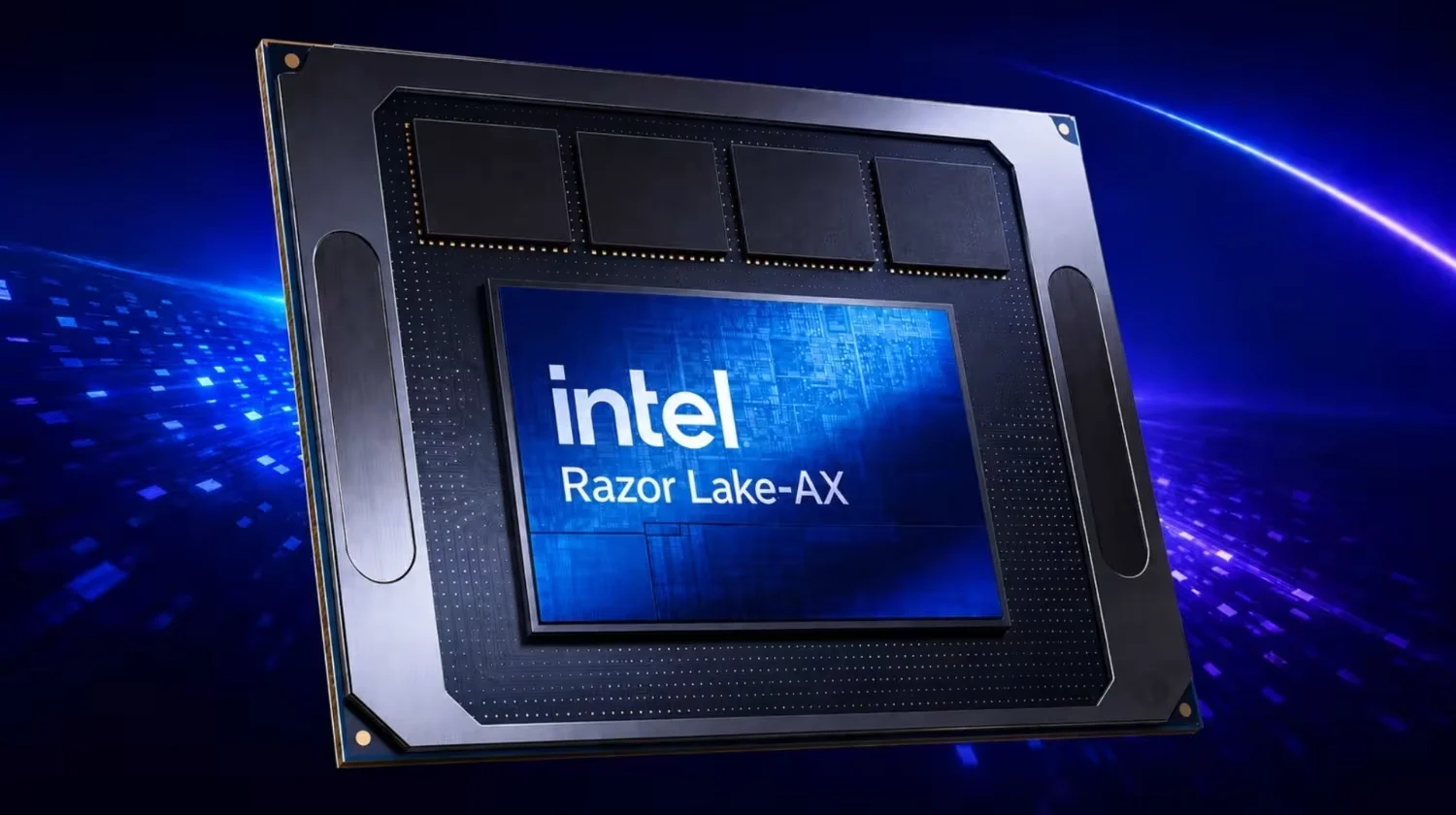
Intel has revealed the launch window for its next generation of Razor Lake-AX processors, setting their arrival for 2028.
The confirmation took place during the Semiconductors Powering Humanoids conference in South Korea, where Cho Min-sung, an executive of the company, unveiled the brand’s roadmap focused on autonomous systems, industrial robotics and humanoid robots.
The main appeal of Razor Lake-AX lies in its AI-focused processing power. Intel aims to achieve 700 TOPS (teraoperations per second) of AI performance with these chips. This figure is nearly four times the theoretical capacity of its current Panther Lake-based platform (Core Ultra Series 3), which offers up to 180 TOPS combined. According to the roadmap, the Nova Lake architecture will precede this launch in early 2027, serving as a bridge before the generational leap in 2028.
Intel Confirms Razor Lake-AX Processor Launch for 2028

Previously, references to Razor Lake-AX had been detected in diagnostic tools like HWiNFO, and various leaks suggested it would incorporate between 16 and 32 Xe3P architecture graphics cores, expanded memory bandwidth, and even integrated memory. With this design, the company aims to position itself as a robust alternative to the integrated SoCs of competitors like AMD and its Ryzen AI Max chips.


Despite the significant leap forward compared to its current chips and platforms like Nvidia‘s Jetson AGX Orin (275 TOPS), the robotics market is advancing at a frenetic pace. Nvidia has already showcased its Jetson Thor platform, capable of achieving higher levels of computational precision in FP4, although Intel has not yet specified what numerical precision it will use to measure its 700 TOPS.
Intel anticipates that the first commercial autonomous mobile robots based on its platforms will begin production in 2027, paving the way for humanoid systems to adopt Razor Lake-AX starting in 2028.
Get more eTeknix in GoogleAdd us as a preferred source and our stories show up more often in Google's Top Stories.


